Pen Down, Window Up: The Food Critics Who Traded Reviews for Recipes on Wheels
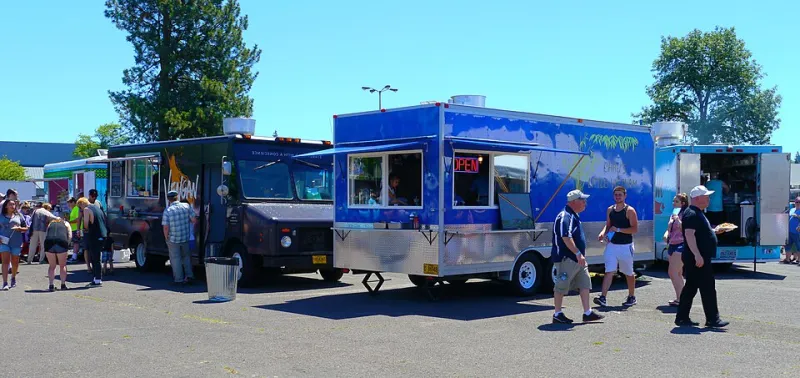
Photo: Rick Obst, CC BY 2.0, via Wikimedia Commons
For years, they were the ones holding the power. A well-placed two-star review could empty a dining room for weeks. A glowing write-up in a major Texas publication could have reservations booked out for months. Food critics and restaurant journalists occupied a peculiar, influential corner of the culinary world — close enough to taste everything, removed enough to judge it fairly.
But something has been shifting quietly across the Lone Star State. A small but growing number of these same writers and reviewers are swapping their press credentials for a commercial kitchen license, trading editorial deadlines for lunch rushes, and rolling into the Texas food truck scene with something to prove — or maybe something to finally express.
The View from the Other Side of the Window
Ask anyone who has made this transition and they'll tell you the same thing first: nothing prepares you for the physical reality of running a food truck. Not a single restaurant visit, not a decade of dining columns, not even a culinary school certificate hanging on the wall.
"I had eaten at probably four hundred food trucks across Texas over ten years," says one former Austin-based food journalist who launched a smash burger concept out of a retrofitted trailer two years ago. "I thought I understood the operation. I did not understand the operation."
The learning curve, by most accounts, is steep and unforgiving. Prep starts before sunrise. The service window demands a kind of controlled chaos that no amount of observation fully captures. Equipment breaks at the worst possible moments. And unlike the critic who can simply not return to a restaurant that disappointed them, the operator has to face every customer, every day, with something worth serving.
What's interesting, though, is that the former critics aren't running from their past — they're drawing directly from it.
Knowing What's Good Before You Cook It
Here's the advantage nobody talks about enough: food critics, by the nature of their work, develop an almost encyclopedic understanding of what works on a plate and what doesn't. They've tasted hundreds of variations of the same dish. They've watched trends emerge, peak, and fade. They know — often before most operators do — when a concept has legs and when it's just a moment.
That kind of pattern recognition turns out to be remarkably useful when you're designing a food truck menu.
"I knew exactly what I didn't want to do," explains a former Houston restaurant columnist who now runs a Vietnamese-Tex-Mex fusion truck that's built a serious following at local festivals. "I'd reviewed enough gimmick concepts to know that novelty alone doesn't keep people coming back. You need something that actually tastes great on the third visit, not just the first."
This editorial instinct — the ability to evaluate a dish with some emotional distance — gives former critics a cleaner eye when developing recipes. They're less attached to a dish because they invented it and more willing to cut it if it isn't performing. That's a discipline a lot of first-time operators struggle with.
The Credibility Question
Of course, not everyone in the Texas food community has welcomed this transition with open arms. There's a real conversation happening — sometimes out loud, sometimes just under the surface — about whether former critics deserve the same respect as operators who came up through professional kitchens, or who spent years grinding in the industry before ever opening a window.
It's a fair tension. The food truck scene in Texas is crowded, competitive, and built on genuine hustle. Showing up with a byline and a strong palate isn't a substitute for culinary training or real kitchen experience.
Most of the critics-turned-operators we spoke to are the first to acknowledge this. Several have gone back to work under experienced chefs before launching, specifically to earn the kitchen credibility they lacked. Others have brought on culinary partners who handle execution while they focus on concept, branding, and the business side — areas where their media backgrounds actually shine.
"I'm not pretending I'm a trained chef," says the Austin-based operator. "But I know how to tell a food story, I know how to build a brand, and I know what people in this city are genuinely hungry for. I found a partner who can cook circles around me, and together we make it work."
Festival Life Through a Different Lens
One place where the former-critic background pays obvious dividends is at events like Texas Food Truck InFest. These operators know how festivals work from the consumer side in a way that many first-time vendors simply don't. They've attended dozens of them. They've watched which trucks draw lines and which ones get skipped. They understand pacing, presentation, and the importance of a menu that travels well and sells fast under pressure.
That awareness shapes how they approach a festival setup — from the way they position their signage to the specific dishes they feature when the crowd is thick and the wait time needs to stay short.
"At a festival, you have maybe thirty seconds to make someone stop walking," says the Houston columnist-turned-operator. "I've written about that dynamic a hundred times. Now I'm living it, and I'll tell you, it hits different when it's your truck they're walking past."
What They're Actually Cooking
The concepts these former critics are bringing to Texas roads are as varied as the beats they used to cover. There's comfort food elevated just enough to feel intentional. There's regional Mexican cuisine executed with genuine respect for tradition. There's the occasional wildcard concept that only makes sense if you understand the broader arc of where Texas dining has been heading for the last decade.
What most of these menus share is a kind of thoughtfulness — a sense that every item on the board has been considered and reconsidered, tasted and revised, positioned with intention. It's the culinary equivalent of a well-edited article, and honestly, it shows.
Rolling Into Something Real
The critics who've made this leap will tell you it's humbling in ways they didn't anticipate. The physical demands, the financial risk, the vulnerability of putting your own cooking in front of people who might not love it — none of that has a comfortable parallel in the press box.
But there's also something they describe as a kind of relief. Years of observing and evaluating and commenting from the outside eventually creates its own kind of restlessness. The food truck, for all its chaos and early mornings and mechanical headaches, is a place where the work is immediate and the feedback is instant. Nobody sends you a letter to the editor. They just come back — or they don't.
For these former critics, that directness is the whole point. They spent a long time writing about other people's food. Now they're making something of their own, rolling it out to the Texas public one festival at a time, and finding out what it feels like to be on the receiving end of the verdict.